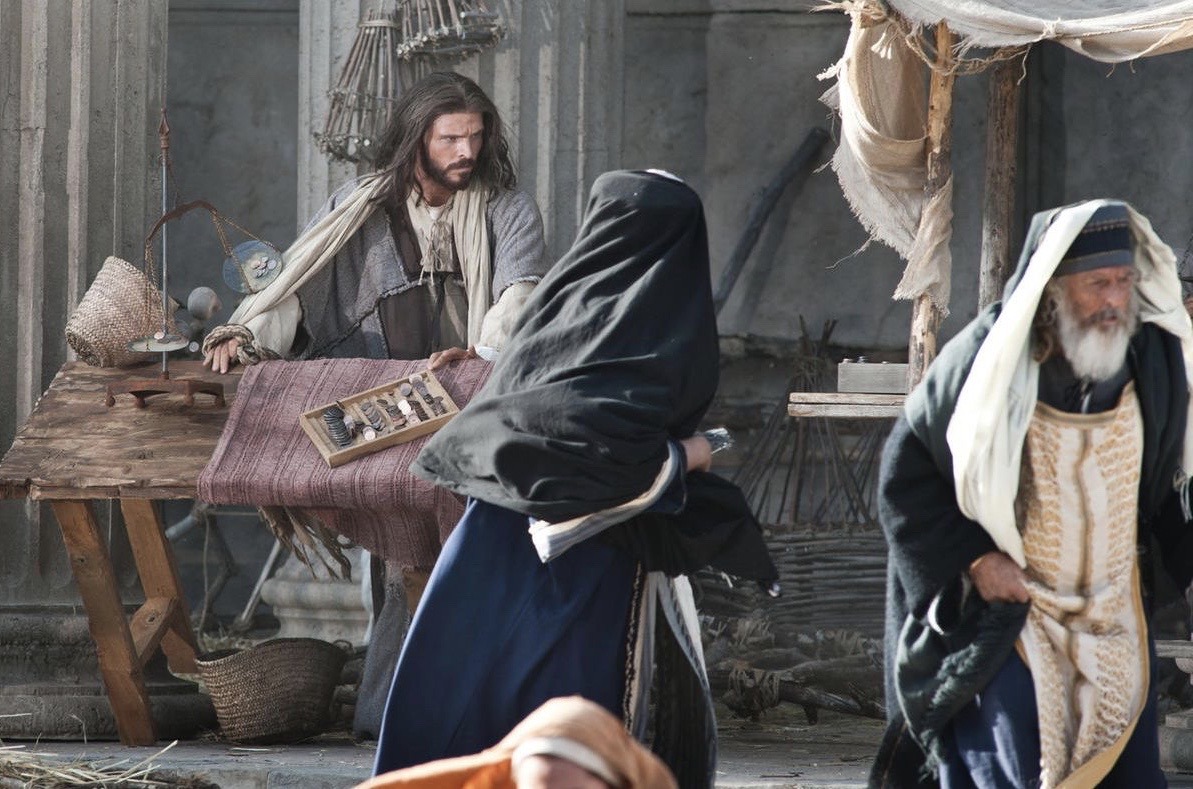
To understand thoroughly, we need to know why Jesus flipped those tables!
Interestingly enough, our tax-due deadline this year of 2025 in the United States falls on April 15th, right at the same time our own Holy Week observations have been focused on Christ’s flipping of the money changers’ tables at The Temple.
It needs to be understood that in 30 A.D. The Jewish people had a pretty hefty religious tax obligation to the Priesthood and the Temple, and civil taxes as well, to keep up with Rome.
Starting a little bit earlier in the story, let’s look at this together.
“As Jesus looked up, he saw the rich putting their gifts into the temple treasury. He also saw a poor widow put in two very small copper coins. “Truly I tell you,” he said, “this poor widow has put in more than all the others. All these people gave their gifts out of their wealth, but she, out of her poverty, put in all she had to live on.” Some of his disciples remarked that the temple was adorned with beautiful stones and gifts dedicated to God. But Jesus said, “As for what you see here, the time will come when not one stone will be left on another; every one of them will be thrown down.” ~ Luke 21:1-6
Here is what it was according to the Old Covenant!
Religious tax: A half shekel in the amount of 2 days’ wages for the upkeep and maintenance of the Temple grounds.
Sacrificial: Korban Pesach in the amount of 1 lamb per household to stay in line with the Passover commandment. A requirement for Jewish pilgrims to purchase a lamb to be offered at the Temple.
Pilgrimage offering: Chagigah in the amount of a burnt offering and two peace offerings was brought to the Temple in Jerusalem on the three pilgrimage festivals of Passover, Shavuot, and Sukkot.
Tithes: Ma’aserot (1st tithe) in the amount of 10% of your produce that went to the Priesthood.
Ma’aser Sheni (2nd tithe) in the 1st, 2nd, 4th, and 5th years of a 7-year sabbatical cycle. A tithe that had to be eaten in Jerusalem no matter where you were coming from.
Ma’aser Ani (an additional tithe for the poor) to be given in the 3rd and 6th years of the sabbatical cycle in place of the above-mentioned Ma’aser Sheni. To be given to the poor instead of eaten.
and then of course all of their Civil Roman tax obligations as well.
The Roman Imperial Tribute: Land taxes, customs, census tax…
It was a heavy and becoming unbearable financial yoke on the necks and backs of the Jewish people. While Rome’s occupation and colonization of the land was making the elitists wealthier, it was getting harder and harder for the people, many barely making it, if making it at all, trying to do business and survive on leased-out land that was now predominantly owned by the Herodian Dynasty (their kings) and the Roman Empire.
Now, here’s where the money changers and capitalists of the day saw an opportunity to extort and profit from so many already stressed, poor, struggling people.
The Jewish people who were mandated by The Law of Moses to keep these religious tithe and tax obligations had to make a trip to The Temple in Jerusalem once a year during Passover from all over The Roman Greco world couldn’t always afford to bring all of their tithe obligations, let alone the requirements of those obligations like a lamb without blemish from all the dispersed territories and regions they were coming from.
For many, just getting to Jerusalem itself would have depleted them of all they had to live on…
So when they did arrive at the Temple in Jerusalem, they were met with what looked more like a flea market than the dwelling place of God.
They were met with peddlers and profiteers selling doves, pigeons, cattle, and lambs for the poor to buy and offer at the Temple lest they be cursed by God.
As for the Temple Tax, the half-shekel money obligation due to the Temple, the only coin that was acceptable was the Tyrian Shekel. A small silver coin minted in Tire that didn’t have any pagan god, images, symbols, or foreign rulers’ faces on it.
Take note of when the Pharisees were trying to accuse Jesus of encouraging his followers to not pay the Imperial Roman Tribute Tax and how he responded to them:
“Tell us then, what is your opinion? Is it right to pay the imperial tax to Caesar (Rome) or not?” But Jesus, knowing their evil intent, said, “You hypocrites, why are you trying to trap me?
“They brought him a denarius (a Roman silver coin), and he asked them, “Whose image is this? And whose inscription?”
“Caesar’s,” they replied. Then he said to them, “So give back to Caesar what is Caesar’s, and to God what is God’s.”
When they heard this, they were amazed. So they left him and went away.”
~ Matthew 22:17-22
It’s important to understand that many of the pilgrimaging Jews coming from all over the Roman-Greco world of 30 A.D. would have arrived in Jerusalem with foreign currencies (like the denarius) that would have to be exchanged for the Tyrian Shekel before they could fulfill their religious temple tax obligations.
This allowed the money changers to charge high, predatory foreign-exchange transaction fees, adding even more of a financial burden to Judaism’s faithful, just wanting to obey The Law of Moses and thus stay in God’s good graces…
Let’s reflect again…
“Truly I tell you,” he said, “this poor widow has put in more than all the others. All these people gave their gifts out of their wealth, but she, out of her poverty, put in all she had to live on.” ~ Luke 21:3-4
“As for what you see here, the time will come when not one stone will be left on another; every one of them will be thrown down.” ~ Luke 21:6
As I hope you can see here, Jesus wasn’t really happy with what was going on and with what had become of The Priesthood and the temple. A holy place and a centrifuge of Jewish worship that was once a place of prayer and hope for the people. A holy place that was about atonement, and a sense of yearly forgiveness, now having become a heavy yoke of financial burden, extortion, and oppression that was doing business with the Roman Empire and their Jewish Kings (The Herods).
Thus, our Holy Week Meditation:
“The Passover of the Jews was near, and Jesus went up to Jerusalem. And within the temple grounds, He found those who were selling oxen, sheep, and doves, and the money changers seated at their tables. And He made a whip of cords, and drove them all out of the temple area, with the sheep and the oxen; and He poured out the coins of the money changers and overturned their tables; and to those who were selling the doves He said, “Take these things away from here; stop making My Father’s house a place of business!” ~ John 2:13-16
As Luke records the day;
“When Jesus entered the temple courts, he began to drive out those who were selling. “It is written,” he said to them, “‘My house will be a house of prayer’; but you have made it ‘a den of robbers.’” ~ Luke 19:45-46
Matthew says;
“Jesus entered the temple courts and drove out all who were buying and selling there. He overturned the tables of the money changers and the benches of those selling doves.” ~ Matthew 21:12
and Mark recalls;
“He began to teach and say to them, “Is it not written: ‘My house will be called a house of prayer for all the nations’? But you have made it a den of robbers.” And the chief priests and the scribes heard this, and they began seeking how to put Him to death; for they were afraid of Him, because all the crowd was astonished at His teaching.” ~ Mark 11:15-18
This brings us to where our meditation and observances should be at this point of Holy Week as we continue to make our way to The Inauguration of The New Covenant, His Arrest and Crucifixion, His Descent and Resurrection, and ultimately His Ascension to The Right-Hand Side of The Father for His Eternal Crowning of Lord and King Over All Creation, Heaven and Earth…
No surprise, Jesus’ followers, empowered by His Spirit, following Pentecost after His Ascension and Crowning, began a ministry of caring for widows and orphans on those very same temple grounds…
“Thy Kingdom Come. Thy Will Be Done On Earth, as it is in Heaven.”
~ Matthew 6:10
~ Stay in Love,
ScottBoggs of The Potter’s Church and Potter’s Hand Thrift Store
 Blogs by Pastor Boggs
Leave a comment